What is Jain Symbol?
In the year 1975, the Jain community celebrated the 2500th anniversary of the nirvana of Lord Mahavir. In this year, it was decided to design a symbol which will be universal for all the Jains. The symbol has three parts: i) a palm with chakra, ii) Aum or Swastika, iii) a crescent with dots. The symbol is covered with an outer line and a phrase in prakrit “Parasparopgraho Jivanam” written at the bottom of the symbol.
The palm is a gesture of support and blessing with a commitment that I am always with you. On the palm is inscribed a chakra with “ahimsa” written at the center. The chakra (wheel) drawn on the palm symbolizes sansar (life on this earth) and the 24 spokes represent 24 tirthankars. The word ahimsa shows the gesture of no unpleasant or cruel activity with anybody. The phrase at the bottom “Parasparopgraho Jivanam”states that Jiva (life) on earth are interdependent and needs mutual support.
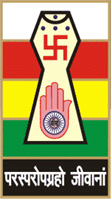 | 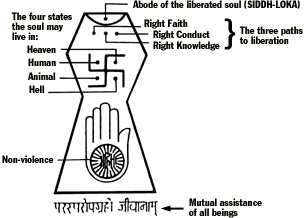 |
Just above the palm, a swastika is drawn with four arms. They represent our birth in four different forms according to our past deeds (karma). The four dots represent dev, human, animal and asur or rakshas. Another group of Jains has accepted Aum (Om) instead of Swastika as shown in the figure below. Aum is regarded as a shortened version of Panch Paramesthi A+A+A+U+M. They are arihant, asariri or siddha, acharya, upadhyay and muni. The half crescent of the moon with a dot drawn at the top of the diagram represents Siddhashila, the abode of siddha purush (liberated soul). The dots below the crescent signifies Triratna i.e., Samyak Darshan, Samyak Jnan and Samyak Charitra.
The outline of the Jain symbol represents the Lok (universe) which is divided into three parts as shown in the outline. The lower portion represents Adholok (hell), the middle portion Madhyalok or simply Lok (universe) and the upper portion Urdhvalok (heaven). The crescent drawn on the top represent siddhalok.


Comments
Post a Comment